Will Other States Follow? Trey’s Law — Born in Missouri — Is Now a National Movement.
Trey’s Law is named for Trey Carlock, a Missouri man who was sexually abused as a child at Camp Kanakuk in Branson. After his abuser was sentenced to multiple life terms in 2010, Trey pursued civil litigation to hold others accountable. That process ended with a settlement — and a nondisclosure agreement that barred him from ever speaking publicly about his abuse or Kanakuk’s role in it.
“They will always control me, and I’ll never be free.”
— Trey Carlock, to his therapist, before his death by suicide at age 28
His sister, Elizabeth Phillips, founded the movement that bears his name. The legislation it produced is straightforward: NDAs in civil settlements involving child sexual abuse and trafficking claims are void and unenforceable as a matter of public policy. Predators and the institutions that enabled them can no longer purchase a survivor’s silence as a condition of compensation.
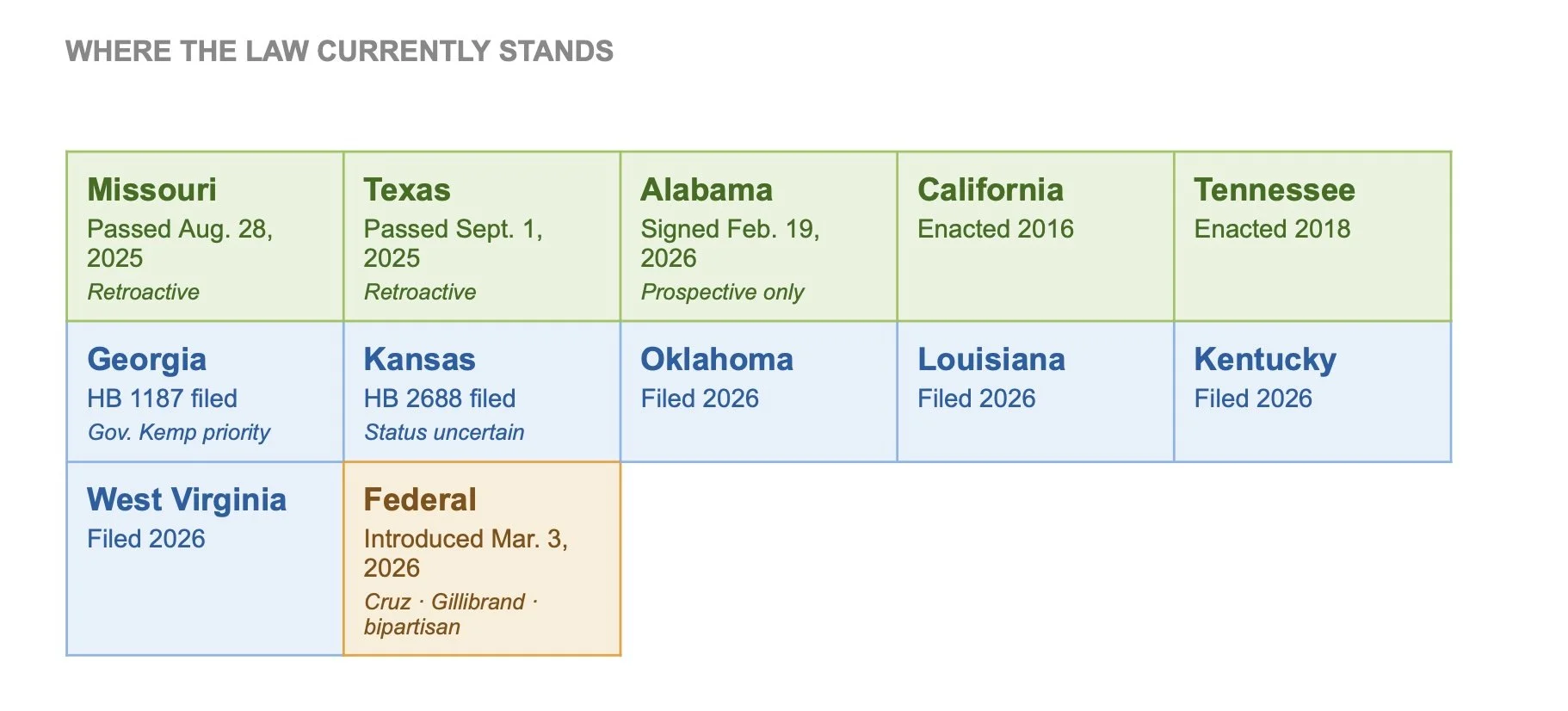
Missouri passed Trey’s Law on August 28, 2025. Texas followed on September 1, 2025 — both with unanimous, bipartisan support, and both applying retroactively to existing NDAs. Those two statutes broke open a national conversation that had already been building. California banned NDAs in sexual abuse settlements in 2016; Tennessee followed in 2018. But the Trey’s Law movement has turned what were isolated state reforms into a coordinated legislative push.
Alabama signed its version into law on February 19, 2026, adding a fifth state to the list — though with an important limitation: the Alabama statute applies only to NDAs dated October 1, 2026 or later. No retroactivity. For survivors already bound by existing agreements, Alabama’s law offers no immediate relief. Missouri and Texas, by contrast, voided those agreements on the day their statutes took effect.
The pipeline beyond those five states is substantial. Georgia’s House Bill 1187 carries Governor Brian Kemp’s personal support as a priority bill of the First Lady’s GRACE Commission. Kansas, Oklahoma, Louisiana, Kentucky, and West Virginia have all filed versions this session. Kansas House Bill 2688, introduced in February 2026, was received by the House Judiciary Committee; its current status is uncertain and worth monitoring. At the federal level, Senators Cruz and Gillibrand introduced a bipartisan bill on March 3, 2026, co-sponsored by Senators Britt, Schmitt, Welch, and Klobuchar. The Senate Judiciary Committee held a hearing on April 30 but Chairman Grassley held the bill for further review rather than advancing it to a vote — a delay, not a defeat.
The legal significance of this movement is real and immediate. For years, institutions facing civil claims for child sexual abuse — schools, camps, churches, sports organizations — have routinely conditioned settlements on the survivor’s permanent silence. Those agreements served the institution, not the survivor. They allowed the same personnel and the same systemic failures to remain hidden from the next family that walked through the door.
Defenders of the status quo argue that NDAs allow institutions to settle claims quietly and implement reforms without public pressure. That argument has appeared in legislative testimony in multiple states, including Alabama. It should be rejected on its own terms: the “reform” argument assumes that institutions will self-correct when given cover to do so. The record at Kanakuk, at Agape, and at countless similar facilities suggests otherwise. Silence is not reform. It is concealment.
What Trey’s Law recognizes is what courts and legislatures are increasingly willing to say plainly: a child’s right to speak about their own abuse cannot be contracted away. The private resolution of a civil claim does not extinguish a survivor’s voice.
For survivors in Missouri, that protection is already law. For those in other states, it may be soon. In the meantime, any NDA signed as part of an abuse settlement — regardless of how it is worded — deserves careful legal review. The enforceability landscape is shifting. What appeared to be a permanent bar on speaking may not be.
If you or someone you know experienced sexual or physical abuse at a boarding school, camp, church, or other institutional setting — and particularly if a prior settlement included a nondisclosure agreement — our firm represents survivors throughout Missouri and beyond. We work quietly, with strategy, and without regard for how powerful the institution on the other side may be.
Representing Survivors of Institutional Abuse
McGonagle Johnson represents survivors of sexual and physical abuse in Missouri and across the country. If you were harmed by an institution — or silenced by a settlement — we can help. Consultations are confidential.